

bitcoin
Bitcoin (BTC) $ 66,178.00
ethereum
Ethereum (ETH) $ 2,030.26
tether
Tether (USDT) $ 0.9997
xrp
XRP (XRP) $ 1.29
bnb
BNB (BNB) $ 579.28
usd-coin
USDC (USDC) $ 1.00
solana
Solana (SOL) $ 78.21
tron
TRON (TRX) $ 0.316117
figure-heloc
Figure Heloc (FIGR_HELOC) $ 1.03
staked-ether
Lido Staked Ether (STETH) $ 2,265.05
dogecoin
Dogecoin (DOGE) $ 0.089786
usds
USDS (USDS) $ 1.00
whitebit
WhiteBIT Coin (WBT) $ 50.77
leo-token
LEO Token (LEO) $ 10.02
bitcoin-cash
Bitcoin Cash (BCH) $ 443.22
cardano
Cardano (ADA) $ 0.236482
wrapped-steth
Wrapped stETH (WSTETH) $ 2,779.67
hyperliquid
Hyperliquid (HYPE) $ 34.77
monero
Monero (XMR) $ 329.33
wrapped-bitcoin
Wrapped Bitcoin (WBTC) $ 76,243.00
chainlink
Chainlink (LINK) $ 8.48
binance-bridged-usdt-bnb-smart-chain
Binance Bridged USDT (BNB Smart Chain) (BSC-USD) $ 0.998762
ethena-usde
Ethena USDe (USDE) $ 0.999453
wrapped-beacon-eth
Wrapped Beacon ETH (WBETH) $ 2,466.93
canton-network
Canton (CC) $ 0.142679
stellar
Stellar (XLM) $ 0.16182
memecore
MemeCore (M) $ 2.55
wrapped-eeth
Wrapped eETH (WEETH) $ 2,465.31
dai
Dai (DAI) $ 0.999922
usd1-wlfi
USD1 (USD1) $ 0.999304
susds
sUSDS (SUSDS) $ 1.08
paypal-usd
PayPal USD (PYUSD) $ 1.00
litecoin
Litecoin (LTC) $ 51.67
zcash
Zcash (ZEC) $ 233.71
coinbase-wrapped-btc
Coinbase Wrapped BTC (CBBTC) $ 76,366.00
rain
Rain (RAIN) $ 0.007902
avalanche-2
Avalanche (AVAX) $ 8.67
hedera-hashgraph
Hedera (HBAR) $ 0.085945
weth
WETH (WETH) $ 2,268.37
shiba-inu
Shiba Inu (SHIB) $ 0.000006
sui
Sui (SUI) $ 0.8491
the-open-network
Toncoin (TON) $ 1.21
usdt0
USDT0 (USDT0) $ 0.998824
crypto-com-chain
Cronos (CRO) $ 0.069033
bittensor
Bittensor (TAO) $ 295.83
world-liberty-financial
World Liberty Financial (WLFI) $ 0.09804
hashnote-usyc
Circle USYC (USYC) $ 1.12
tether-gold
Tether Gold (XAUT) $ 4,596.26
pax-gold
PAX Gold (PAXG) $ 4,613.64
blackrock-usd-institutional-digital-liquidity-fund
BlackRock USD Institutional Digital Liquidity Fund (BUIDL) $ 1.00

Ethereum Faces Validator Bottleneck With 2.5M ETH Awaiting Exit

Ethereum’s proof-of-stake system is facing its largest test yet. As of mid-September, roughly 2.5 million ETH — valued at roughly $11.25 billion — is waiting to leave the validator set, according to validator queue dashboards.

The backlog pushed exit wait times to more than 46 days on Monday, the longest in Ethereum’s short staking history, dashboards show. The last peak, in August, put the exit queue at 18 days.

The initial spark came on Sept. 9, when Kiln, a large infrastructure provider, chose to exit all of its validators as a safety precaution. The move, triggered by recent security incidents including the NPM supply-chain attack and the SwissBorg breach, pushed around 1.6 million ETH into the queue at once. Though unrelated to Ethereum’s staking protocol itself, the hacks rattled confidence enough for Kiln to hit pause, highlighting how events in the broader crypto ecosystem can cascade into Ethereum’s validator dynamics.

In a blog post from staking provider Figment, Senior Analyst Benjamin Thalman noted that the current exit queue build up isn’t only about security. After ETH has rallied more than 160% since April, some stakers are simply taking profits. Others, especially institutional players, are shifting their portfolios exposure.

At the same time, validators entering the Ethereum staking ecosystem have been steadily rising. The SEC’s May statement clarifying that staking is not a security has renewed interests in staking. Anticipation of ETH ETF approvals is another driver, as funds prepare for regulated ways to capture staking yield, Thalman noted.
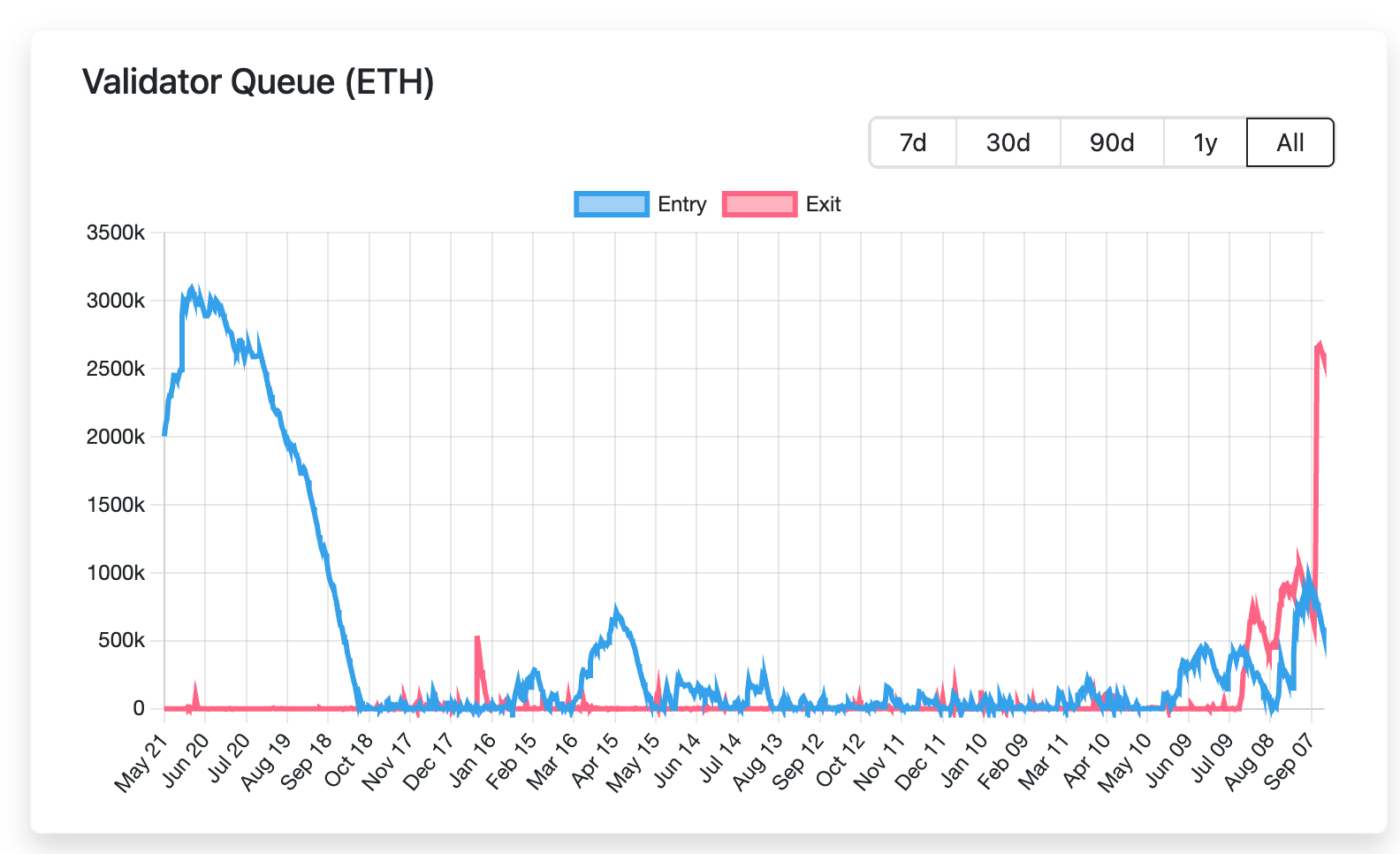
ETH validator entry and exit queue (validatorqueue.com)

Ethereum’s churn limit, which is a protocol safeguard that caps how many validators can enter or exit over a certain time period, is currently capped at 256 ETH per epoch (about 6.4 minutes), restricting how quickly validators can join or leave the network, and is meant to keep the network stable.

With more than 2.5M ETH lined up, stakers on Wednesday face 44 days before even reaching the cooldown step.

Thalman believes that much of the ETH existing will simply be restaked under new validators, meaning that if even 75% of the current queue is re-deposited, nearly 2 million ETH will flood the activation queue, bringing delays for new ETH staking, and a backlog on both sides of the validator queue.

“The activation queue is currently 13 days, to this add the ~2M ETH from those currently exiting (35 days) and 4.7M from ETFs (81 days), and the total is 129 days. This assumes that there are no other ETH holders that choose to stake and enter the queue, like corporate treasuries,” Thalman wrote in the blog.

The swelling queue underscores a paradox: Ethereum is working «as intended” Thalman notes, and the demand to both exit and re-enter highlights staking’s central role in the ecosystem. The network is thus experiencing the growing pains of a maturing, institutionalized system where infrastructure scares, profit cycles, and regulatory shifts all collide in real time.

Read more: Ethereum Staking Queue Overtakes Exits as Fears of a Sell-off Subside

Más artículos

Future trends in gambling What Mostbet predicts for the industry

Future trends in gambling What Mostbet predicts for the industry Emerging

¡Descubre Pin Up Casino en Guatemala y comienza a jugar hoy mismo!

Descubre todo sobre Pin Up Casino en Guatemala Si eres un

Pin Up GT: La mejor opción para jugar en línea en Guatemala

Pin Up GT: La mejor opción para jugar en línea en

New Alert Safety System Reduces Workplace Accidents Using Instant Alerts: Current Accident News Safety Alerts

Workplace safety has moved into a new chapter with the implementation

Sigue Criptoanálisis

La estrategia ha adquirido casi 14,000 bitcoin en su última compra de la criptomoneda, confiando en Michael

Elección del editor

Future trends in gambling What Mostbet predicts for the industry Emerging Technologies in Gambling The

Descubre todo sobre Pin Up Casino en Guatemala Si eres un aficionado a los casinos

Pin Up GT: La mejor opción para jugar en línea en Guatemala En Guatemala, la

Workplace safety has moved into a new chapter with the implementation of advanced real-time notification

Workplace safety has moved into a new chapter with the implementation of advanced real-time notification

Workplace safety has moved into a new chapter with the implementation of advanced real-time notification

Across communities nationwide, a significant transformation is occurring as residents rediscover the importance of face-to-face

Scroll al inicio